
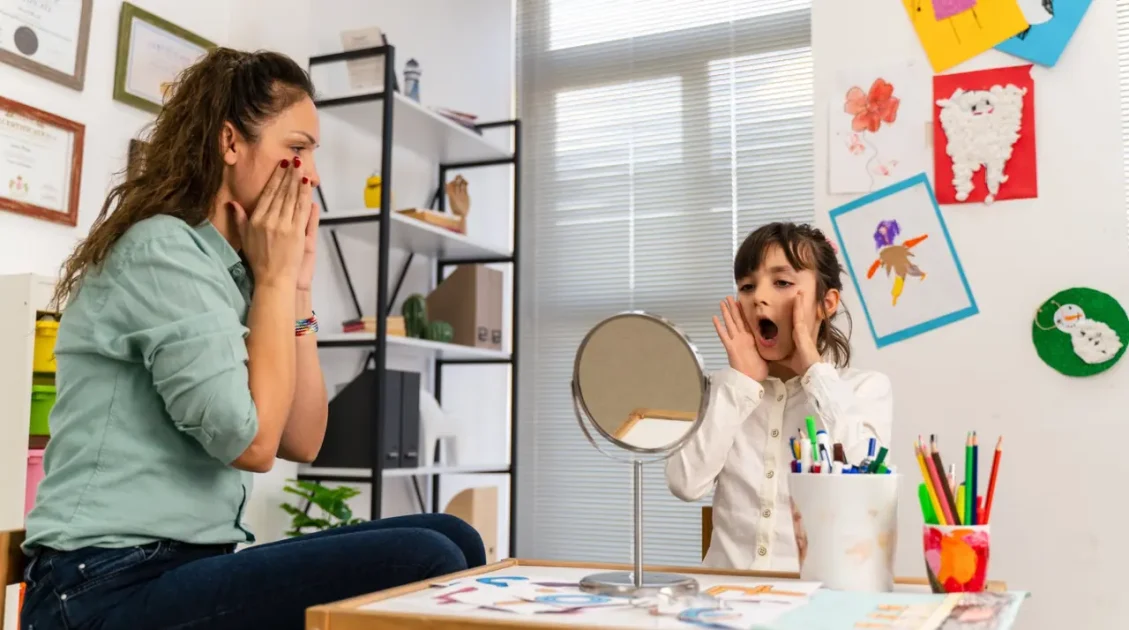
Watching a child grow and discover new ways to communicate is one of the most rewarding parts of parenting. From a baby’s first coos and smiles to a toddler’s curious questions, speech and language skills develop through a series of natural stages. However, every child progresses at their own pace—and when a toddler seems slower to talk than peers, parents often wonder whether to wait or seek a professional evaluation.
Understanding the difference between a mild variation in development and a clinical speech or language delay can help families make informed, timely decisions. In this guide prepared by the clinical team at HV Rehab Centre in Newtown, Kolkata, we walk through age-wise communication milestones, the early signs of speech delay, how hearing and sensory factors play a role, and when to consult a qualified Speech-Language Pathologist (SLP).
Speech Delay vs. Language Delay: Understanding the Difference
Although parents and caregivers often use the terms interchangeably, clinicians distinguish between speech and language during a pediatric evaluation:
- Speech refers to the physical production of sounds—how clearly a child coordinates their lips, tongue, jaw, vocal folds, and breath to form words. Difficulties here may involve articulation (pronouncing specific sounds), fluency (stammering or stuttering), or voice resonance.
- Language refers to understanding and sharing meaning. It has two main parts:
- Receptive language: How well a child understands spoken words, gestures, questions, and everyday instructions.
- Expressive language: How a child uses gestures, sounds, words, and sentences to express needs, thoughts, and feelings.
A child may experience an isolated expressive speech delay (understanding everything said at home while using very few spoken words), a receptive-expressive language delay, or communication challenges associated with hearing difficulties or neurodevelopmental conditions.
Age-by-Age Speech & Language Milestones (0 to 4 Years)
While individual timelines vary, pediatricians and audiologists/speech-language pathologists use developmental milestones as general reference points. The table below outlines typical communication skills from infancy through early childhood:
| Age Range | Receptive Skills (Understanding) | Expressive Skills (Speaking & Gestures) |
|---|---|---|
| 6 – 12 Months | Turns toward familiar voices and environmental sounds; responds to own name by around 9–12 months; understands simple words like “no” or “bye-bye”. | Babbles using consonant-vowel combinations (“ba-ba”, “ma-ma”, “da-da”); uses gestures such as waving, reaching, or pointing to show interest. |
| 12 – 18 Months | Recognizes names of familiar family members, toys, and body parts; follows simple one-step spoken requests accompanied by gestures. | Uses 1 to 3 meaningful first words around 12–15 months; builds a vocabulary of roughly 10 to 20 simple words by 18 months; points to request or share attention. |
| 18 – 24 Months | Follows simple one-step instructions without needing gestures (e.g., “Give me the ball”); points to pictures in a book when named. | Uses at least 50 spoken words by 24 months; begins combining two words into short phrases (e.g., “more milk”, “mama come”). |
| 2 – 3 Years | Understands two-step instructions (e.g., “Pick up your toy and put it in the box”); grasps basic concepts such as in/on, big/small, and action words. | Speaks in 3- to 4-word sentences; asks “what” and “where” questions; speech is understood by family members most of the time. |
| 3 – 4 Years | Understands longer stories, simple “why” and “how” questions, and group instructions in preschool settings. | Uses 4- to 5-word sentences to describe daily experiences; speech is generally understandable to unfamiliar listeners outside the immediate family. |
Early Signs of Speech Delay Parents Should Watch For
Because early childhood is a critical window for brain plasticity and language acquisition, recognizing red flags early allows families to support their child proactively. Consider scheduling a developmental or speech-language assessment if you notice any of the following signs:
By 12 to 15 Months
- Does not babble using consonant sounds (such as p, b, m, d).
- Does not consistently respond when called by name or seems unaware of loud household noises.
- Rarely uses gestures such as pointing, showing objects, or waving goodbye.
- Shows limited eye contact or shared enjoyment during interactive play like peek-a-boo.
By 18 to 24 Months
- Speaks fewer than 10 to 15 recognizable words by 18 months, or fewer than 50 words by age 2.
- Does not combine two words into meaningful phrases by 24 months.
- Prefers pulling a parent’s hand toward an object rather than pointing or vocalizing.
- Has difficulty imitating everyday sounds, actions, or simple words.
- Does not understand simple spoken instructions without visual cues.
By 3 Years and Beyond
- Speaks primarily in single words or echoes phrases (echolalia) without using spontaneous short sentences.
- Family members struggle to understand at least half to three-quarters of what the child says.
- Gets frequently frustrated when trying to communicate basic needs.
- Experiences noticeable blocks, prolongations, or repetitions of sounds (stammering) lasting several months.
- At any age: Any sudden loss or regression of previously acquired babbling, words, or social interaction skills.
Why Do Speech and Language Delays Happen?
A speech delay is a descriptive observation rather than a standalone diagnosis. During a comprehensive evaluation, specialists look at several factors that influence how a child learns to communicate:
1. Hearing Loss and Middle-Ear Conditions
Children learn to speak by listening to the speech sounds around them. Even mild or fluctuating hearing loss—such as fluid buildup from recurrent middle-ear infections (otitis media) or undetected congenital sensorineural hearing loss—can make consonant sounds muffled and indistinct. For this reason, audiologists often recommend objective hearing evaluations such as an OAE (Otoacoustic Emissions) test or BERA (Brainstem Evoked Response Audiometry) test alongside a speech assessment.
2. Oral-Motor and Speech Sound Disorders
Some children understand language well but struggle with the physical coordination required to produce clear speech sounds. Conditions such as tongue-tie (ankyloglossia), childhood apraxia of speech, or oral-motor weakness can affect clarity and syllable sequencing.
3. Neurodevelopmental & Sensory Factors
Speech and language differences can sometimes occur alongside broader developmental conditions, including Autism Spectrum Disorder (ASD), Attention-Deficit/Hyperactivity Disorder (ADHD), global developmental delay, or sensory processing differences. In such cases, a coordinated program combining Speech Therapy and Occupational Therapy helps support both sensory regulation and functional communication.
4. Environmental & Screen-Time Factors
Language thrives on back-and-forth human interaction (“serve and return” communication). Excessive passive screen time on smartphones or television during the first three years of life reduces opportunities for real-world conversation, joint attention, and play-based vocal turn-taking.
Why Avoid the “Wait and See” Approach? In many households, well-meaning relatives reassure parents with phrases like “boys talk late” or “he will speak once he starts school.” While some late talkers do catch up on their own, waiting until age 4 or 5 can make school transition and peer interaction much harder. An early assessment is gentle, play-based, and gives parents peace of mind and practical home strategies.
What Happens During a Speech Therapy Assessment at HV Rehab Centre?
At HV Rehab Centre in Action Area I, Newtown, Kolkata, our pediatric evaluations are designed to feel welcoming and child-friendly rather than clinical or intimidating. A typical first consultation includes:
- Detailed Parent Interview: Reviewing prenatal and birth history, developmental milestones, medical history, ear infections, family history, and daily routines at home.
- Play-Based Communication Observation: Assessing joint attention, eye contact, gesture use, play skills, receptive comprehension, and expressive vocabulary in a relaxed setting.
- Oral-Motor Screening: Checking the structure and movement of the lips, tongue, jaw, and palate during speech and feeding tasks.
- Audiological Screening (When Indicated): Coordinating on-site hearing evaluations—including OAE, Tympanometry, Pure Tone Audiometry, or BERA testing—to rule out hearing barriers.
- Individualized Therapy Plan & Home Program: Sharing clear findings with parents and, when therapy is recommended, setting realistic, measurable goals alongside practical home carryover activities.
You can explore our full range of clinical services on our Specialised Services page or schedule a convenient visit through our Online Appointment page.
5 Practical Ways Parents Can Encourage Speech at Home
Alongside professional guidance, everyday family routines offer wonderful opportunities to nurture a child’s communication skills:
- Narrate Your Daily Routine (Self-Talk & Parallel Talk): Describe what you and your child are doing in simple, clear phrases during bath time, mealtime, and dressing—for example, “Wash hands! Cold water! Soap bubbles!”
- Follow Your Child’s Lead in Play: Sit at eye level and join in with whatever toy or activity holds your child’s attention rather than quizzing them with constant “What is this?” questions.
- Expand on What Your Child Says: If your toddler points and says “Car,” validate and add one word: “Yes, big car!” or “Blue car goes fast!”
- Pause and Create Communication Temptations: Offer a choice between two snacks (“Apple or banana?”) and wait 5 seconds with an expectant smile to give your child space to point, vocalize, or attempt the word.
- Replace Passive Screen Time with Interactive Picture Books: Shared book reading, action rhymes, and pretend play build vocabulary and attention far more effectively than videos.
Frequently Asked Questions (FAQ)
1. What is the best age to start speech therapy for a child with a speech delay?
There is no minimum age to consult a Speech-Language Pathologist. If a baby or toddler is missing key communication milestones—such as not babbling by 12 months, not speaking single words by 16–18 months, or not combining two words by 24 months—early intervention between 18 months and 3 years is highly beneficial.
2. Does bilingualism or speaking multiple languages at home cause speech delay?
No. Growing up in a multilingual household (for example, hearing Bengali, Hindi, and English in Kolkata) does not cause a clinical speech or language disorder. Bilingual children develop concepts across their combined vocabulary at the same overall timeline as monolingual peers. If a true delay is present, it will appear across all languages spoken at home.
3. Should my child have a hearing test (OAE or BERA) before starting speech therapy?
Yes, ruling out hearing loss is a foundational step in evaluating any speech delay. Even mild or partial hearing loss can prevent a child from hearing high-frequency speech sounds clearly. HV Rehab Centre provides child-friendly OAE and BERA diagnostic tests under the same roof in Newtown, Kolkata.
4. How long does pediatric speech therapy take?
The duration of speech therapy depends on the nature of the communication challenge, the child’s age when starting, and consistency with home practice. Some children with mild expressive delays make steady progress within a few months, while children with complex speech-motor or neurodevelopmental needs benefit from longer-term, structured multidisciplinary support.
5. How can I book a speech therapy consultation at HV Rehab Centre in Kolkata?
You can book an evaluation at our Newtown, Kolkata centre (2nd Floor, Ramadhanu Complex, Near Union Bank, Action Area I, Newtown, Kolkata — 700102) by visiting our Appointment Booking page, calling +91 62899 22721, or messaging us directly on WhatsApp during clinic hours (Monday to Saturday, 9:00 AM – 7:00 PM).
