
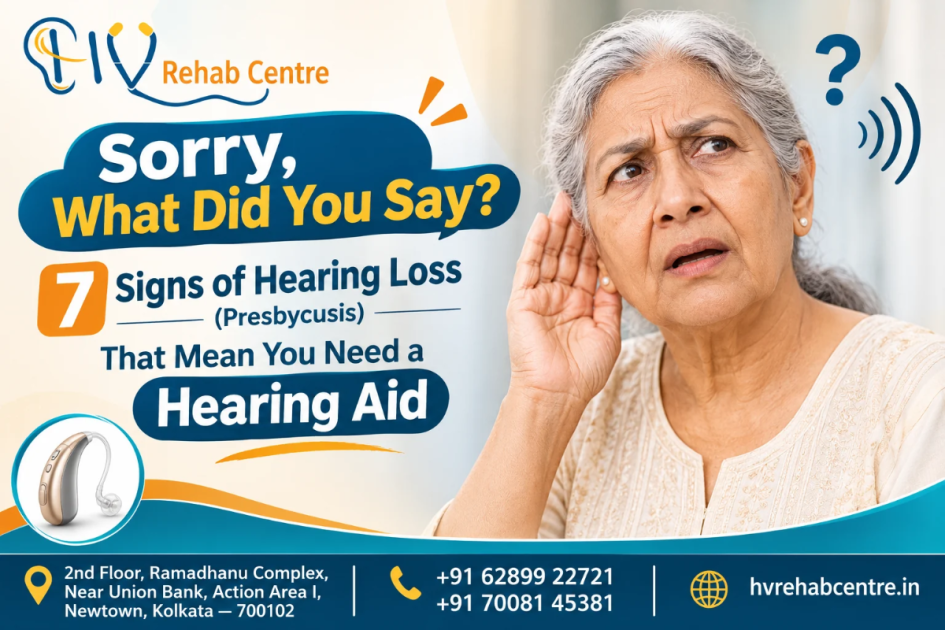
Presbycusis is age-related hearing loss that develops slowly in both ears, usually from the inner ear wearing down over time. Seven signs suggest it is time for a hearing test: asking people to repeat, high TV volume, trouble in noise, muffled speech, missed high-pitched sounds, ringing in the ears, and tiredness after conversations.
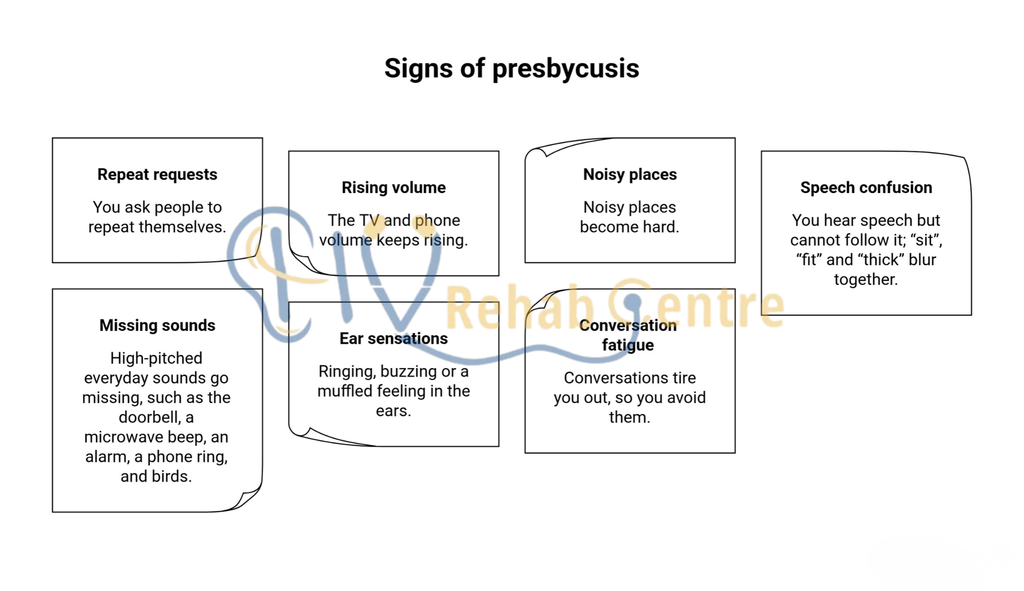
- You ask people to repeat themselves
- The TV and phone volume keeps rising
- Noisy places become hard
- You hear speech but cannot follow it
- High-pitched everyday sounds go missing
- Ringing, buzzing or a muffled feeling in the ears
- Conversations tire you out, so you avoid them
Why families notice before you do
Age-related hearing loss rarely announces itself. It arrives as small changes: a dinner-table conversation you stopped following, a phone call you now hand to someone else, a TV that gets louder every month. The family usually notices first. If you live in Newtown, Rajarhat or Salt Lake, you have probably heard “the line is bad” or “everyone mumbles these days” more than once.
This guide covers seven signs of presbycusis, what a hearing loss assessment involves, what 2026 research says (including where studies disagree), and what to expect from a hearing test and hearing aids in Kolkata. If you are an adult child reading this for a parent, the signs below and the cost-of-waiting section are written for you too.
What is presbycusis?
Presbycusis is gradual hearing loss that comes with age. It affects both ears, usually in a similar way, and starts in the inner ear, where sensory cells and nerve pathways wear down over the years. High-pitched sounds go first, so speech begins to sound unclear rather than simply quiet. Symptoms often start in the 50s or 60s.
Noise adds to the damage: years of traffic, loudspeakers, machinery and loud music all count. Family history, conditions such as high blood pressure and diabetes, and some medicines also play a part. There is no cure, but for most people a hearing aid manages it well.
The 7 signs
1. You ask people to repeat themselves
“Could you say that again?” becomes a habit, and you start to feel that people mumble. Everyday scenario (a composite example, not a patient story): a 66-year-old retired bank officer in Salt Lake tells his wife the family speaks too softly. She has started saying every sentence twice. The family stopped raising it because it ends in an argument.
2. The TV and phone volume keeps rising
You turn the TV up until others leave the room, or you hold the phone harder against your ear. Everyday scenario: a daughter working in Sector V calls her mother in Rajarhat every evening. The mother says the network is poor, on every call. The daughter starts visiting instead, because it is easier than shouting.
3. Noisy places become hard
Healthy hearing separates a voice from the background. Presbycusis blurs the two, so restaurants, wedding halls, puja pandals and metro platforms become tiring. Everyday scenario: a grandfather sits quietly through a family wedding dinner. Relatives read it as grumpiness. In fact he is following about one sentence in four.
4. You hear speech but cannot follow it
Consonants such as s, sh, t, f and th are high-pitched and carry much of the meaning, so “sit”, “fit” and “thick” blur together. You know someone is talking, but the words do not land. Everyday scenario: a grandmother hears her grandchild’s voice clearly but misses the words. She smiles and nods, and the child feels ignored.
5. High-pitched everyday sounds go missing
The doorbell, a microwave beep, an alarm, a phone ring, birds on the morning walk: family members notice these before you do. Losing them is typical of presbycusis, because high pitches fade first.
6. Ringing, buzzing or a muffled feeling in the ears
Tinnitus often comes with age-related hearing loss. Constant or worsening ringing deserves a test. If it appears suddenly or in one ear only, see a doctor promptly.
7. Conversations tire you out, so you avoid them
Straining to follow speech uses real mental effort, and many people respond by withdrawing. Research also links untreated hearing loss with anxiety and low mood. Everyday scenario: a 58-year-old manager in Newtown blames Wi-Fi for missed words on video calls and starts leaving meetings early. The problem is not the connection.
When it is not presbycusis
Age is not always the cause. Earwax, infection or an eardrum problem can mimic it, and some patterns need a doctor first. Get an ENT consultation promptly if you have:
- sudden hearing loss
- loss in one ear only, or loss that worsens quickly
- dizziness, severe ear pain or ear discharge
- neurological symptoms alongside the hearing change
A full audiological evaluation helps sort out which case you are in. Noticed three or more of the signs above? Book a PTA hearing test.
How a hearing loss assessment works
A hearing test for adults is painless. The audiologist asks about your daily listening, noise history and medicines, then looks in the ear. The core of the audiological evaluation is pure-tone audiometry: you wear headphones and press a button each time you hear a soft beep, at different pitches. The result is an audiogram, a chart of the quietest sound you can hear at each pitch. In presbycusis the line usually slopes downward toward the high pitches, in both ears. Speech tests are often added, because understanding words matters more than hearing beeps.
If you want a PTA hearing test in Kolkata with an audiologist in Kolkata, HV Rehab Centre offers PTA as part of its hearing assessment, with senior audiologists on the team. As a hearing test centre in Newtown Kolkata, it sits on the 2nd Floor, Ramadhanu Complex, near Union Bank, Action Area I, and can be reached by the New Garia–Airport metro line and local buses. Newtown is part of the wider Rajarhat area, so families searching for a hearing aid centre in Rajarhat Kolkata or travelling from Salt Lake are within reach.
What recent research says (and where it disagrees)
Hearing loss is often listed among the biggest modifiable risk factors for dementia, so 2026 produced plenty of headlines. Read them with their limits in mind:
- 20 January 2026, Neurology (reported by HealthDay): among adults aged 70+ with moderate hearing loss and no dementia, those prescribed hearing aids had a lower estimated seven-year dementia risk (5.0% versus 7.5%), yet their cognitive test scores did not differ from the others.
- 9 June 2026, University of Hong Kong: pooling 61,089 adults aged 55+ from 33 countries, hearing aid users had a 9% lower risk of probable dementia, and 14% lower when they reported good hearing improvement. The study is observational, so it cannot prove cause.
- 31 August 2026, Yahoo explainer on a three-year trial of 977 adults aged 70–84: no overall cognitive benefit, but decline slowed by 48% in the 238 participants who were already declining fastest.
- 28 September 2026, JAMA Neurology (CHOICE trial, Shanghai): in people with mild cognitive impairment, hearing aids did not significantly cut the rate of progression to dementia (3.09% versus 4.74%), but cognitive improvement was more common (15.34% versus 2.36%).
- October 2026, Daily Excelsior (International Day of Older Persons): a doctor writes that families often notice hearing loss before the person does, and that untreated loss can push older people away from family and religious gatherings.
The honest summary: the dementia evidence is still mixed, so no one should promise that a hearing aid prevents it. What is clear is that a hearing aid helps you hear, and staying in conversation matters.
Hearing aids for senior citizens: choosing a style
Modern digital hearing aids in Kolkata sort sound by pitch, lift the high frequencies that presbycusis removes and reduce background noise. For hearing aids for senior citizens, the right style depends on your audiogram, finger dexterity, whether you wear glasses and your budget. The common hearing aid types are BTE, RIC, ITE and CIC:
| Style | Where it sits | Typically suits | Things to weigh |
|---|---|---|---|
| BTE (behind-the-ear) | Case behind the ear, sound carried by a tube and earmould | Mild to profound loss | Sturdy, easy to handle, long battery life; the most visible |
| RIC (receiver-in-canal) | Small case behind the ear, speaker inside the ear canal | Mild to severe loss, especially sloping high-pitch loss | Discreet and comfortable; thin parts need care and wax can block the receiver |
| ITE (in-the-ear) | Custom shell filling the outer ear | Mild to severe loss | Easier to handle than CIC; more visible than CIC |
| CIC (completely-in-canal) | Custom, deep in the ear canal | Mild to moderate loss | Almost invisible; tiny controls and battery are fiddly, with fewer features |
These are general patterns, not a recommendation. Your audiologist matches the device to your audiogram, so ask which styles suit you and are available.
After the fitting: verification, practice and upkeep
A hearing aid is not an off-the-shelf purchase. Good hearing aid fitting and verification means the audiologist programmes the device to your audiogram and checks that it delivers the right amount of sound at each pitch in your ear. The first weeks can feel loud and strange, because the brain has to relearn sounds it has not heard for years. Aural rehabilitation (listening practice, communication strategies and tips for noisy places) helps with that, and HV Rehab Centre lists it among its services for adults. Hearing aid maintenance and counselling (cleaning, wax care, battery or charging routine, follow-up visits) keeps the device working.
Before you decide, ask about a hearing aid trial and consultation in Kolkata, so you can judge the device in your own routine and understand the follow-up that comes with it.
The cost of waiting
Indian surveys show a wide gap between need and action. In a study of adults aged 60+ across seven states (Scientific Reports, 2022), about 21% reported hearing difficulty, yet only around 5% of them used hearing aids. In national data from the Longitudinal Ageing Study in India (2017–18), just 4.3% of older adults with hearing loss used a hearing aid. Those with hearing loss and no aid had higher odds of trouble with phone calls, managing money and getting around than those with no hearing loss, while hearing aid users did not differ significantly.
The everyday cost is quieter. Conversations shrink, family gatherings start to feel like work, and anxiety and low mood become more likely. Public health guidance also notes that hearing aids are easier to fit and adapt to when started early.
Conclusion
Presbycusis is common, gradual and manageable. If you recognise even a few of the seven signs, a hearing test is a simple next step, and a properly fitted hearing aid can bring conversations, phone calls and family evenings back within reach. The dementia evidence is still developing, but the case for hearing clearly stands on its own. For a hearing test and hearing aids in Kolkata, start with pure-tone audiometry, bring a family member along, and book a hearing test in Newtown at HV Rehab Centre.
Ready to check your hearing?
Call Us | Message Us | Book an Appointment
HV Rehab Centre · 2nd Floor, Ramadhanu Complex, near Union Bank, Action Area I, Newtown, Kolkata 700102 · +91 62899 22721 · Mon–Fri 9 AM–7 PM, Sat 9 AM–6 PM, Sun by appointment
Frequently asked questions
1. At what age does presbycusis start?
It develops slowly, and symptoms often begin in the 50s or 60s, though timing varies with genes, noise exposure and health conditions. If you notice the signs earlier, get tested rather than waiting for a milestone birthday.
2. Can presbycusis be cured or reversed?
No. The inner-ear changes are permanent. Hearing aids do not restore lost hearing, but they make speech clearer, and most people manage well with them.
3. How do I know whether I need a hearing aid or only a hearing test?
Start with the test. The audiogram shows how much hearing you have lost and at which pitches, and the audiologist advises whether a hearing aid will help. Some people with mild loss need monitoring and listening strategies first; others benefit straight away.
4. What is the hearing aid price in Kolkata?
Price depends on the technology level, style, brand, whether you need one ear or both, and the follow-up included. A fair quote needs your audiogram, so ask for a written estimate after your test. HV Rehab Centre says it recommends devices to suit each person’s lifestyle and budget.
5. Will a hearing aid prevent dementia?
That is not proven. Studies in 2026 found a lower dementia risk in some groups and no overall cognitive benefit in others. Choose a hearing aid to hear better and stay in conversation; treat any brain-health benefit as a possible extra.
6. Why can I hear people but not understand them?
That is the classic presbycusis pattern. High-pitched consonants fade first, so voices stay audible but unclear. Raising the volume does not fix clarity; a hearing aid that lifts the missing pitches does.
Medical disclaimer
This article is for general education and is not a diagnosis or treatment advice. Hearing changes can have causes other than ageing, some of which need urgent care. See a qualified audiologist or ENT doctor for assessment, and seek prompt medical help for sudden hearing loss, loss in one ear, dizziness, ear pain or ear discharge.